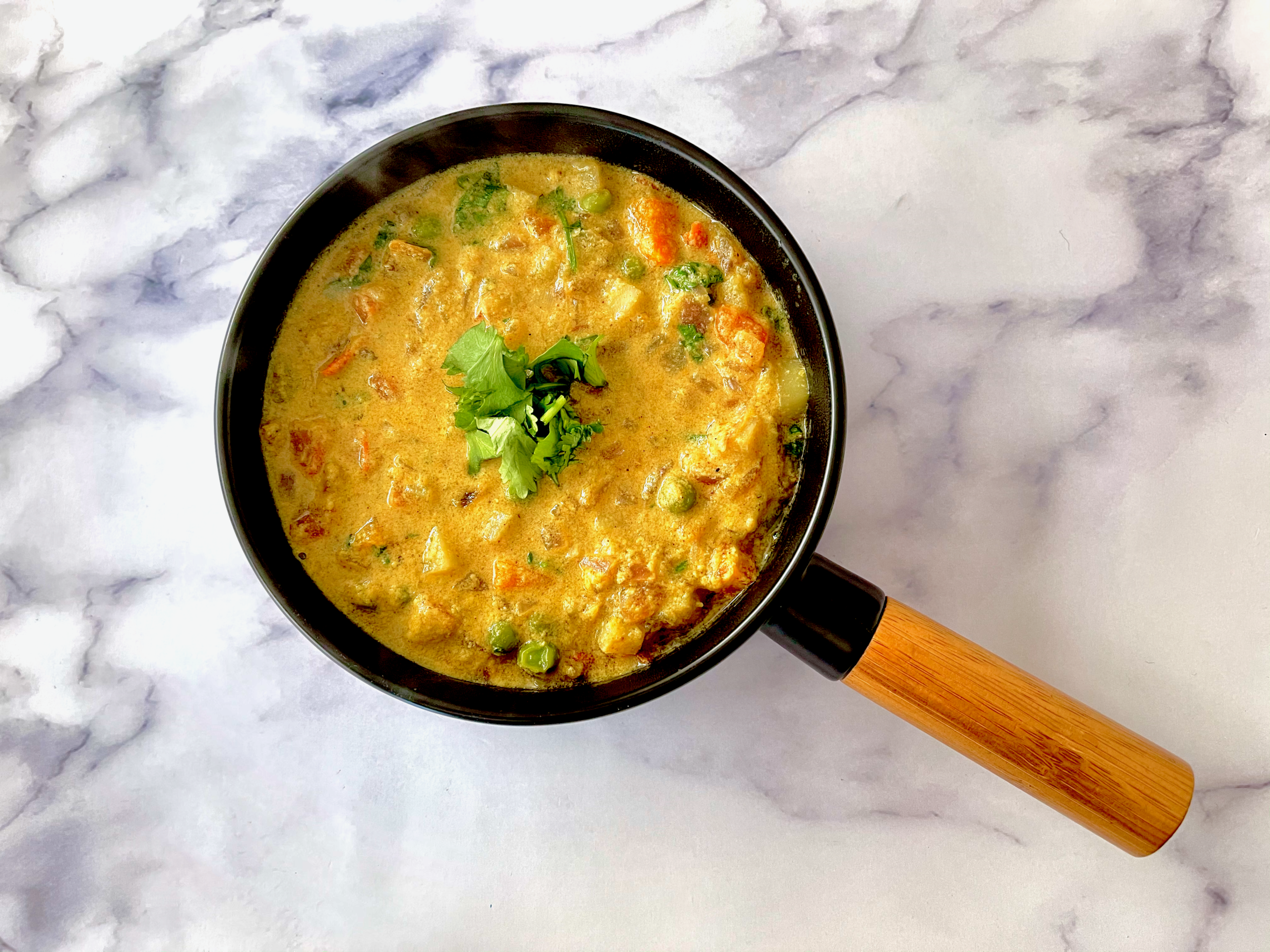
Anyone who has lived or traveled to the South of India will instantly recognize the warm, floral curry sitting alongside greasy, flaky flatbreads. The people line up for the flaky bread, but the fennel-heavy Vegetable Kurma cuts the oil, making this simple curry a casual cult among South Indian culinary favorites. Whether you wake up craving the familiarity of home or simply can’t get those floral notes out of your mind, having a good Kurma recipe is a keeper for the recipe book.
Why is it Kurma and not Korma?
Simply because Kurma is from the South and Korma is from the North. The word Kurma may have taken root in the Mughalai kitchens from the Turkish word for a braised meat dish, Kavurma, during the Persian invasion of India.
As the Mughlai cuisine spreads its roots to other parts of India, the word Kurma may have linguistically adapted to a version of the Mughlai Qorma/Korma, by infusing the Southern dialect that has a distinct “U” sound over the prominent “O” sound of the north.
Most Indians who grew up around this dish can identify the subtle differences between every variation or inspiration of Kurma – be it a South Indian Kurma, Mughlai Korma, Navratan Korma, Kerala Ishtew, and, as much as it hurts me to say this, the British Korma. So no, it’s not Korma that we’re discussing in this blog. It’s Kurma!
How is Kurma different from other Indian curries?

Kurma is as complex as the word curry itself. With every region and diaspora making it their own, Kurma can be very personal. But the thought that South Indian folk everywhere get when they hear the word Kurma is the nostalgic whiff of botanic notes rising from a fast food joint.
Though it originates in Persia, Mughlai curries and kormas tend to be richer and robust in flavor, whereas the curries of the South appreciate the cleaner, fresher flavors of natural fruits and vegetables. This is evident in the way Kurma is prepared in the South.
Kurma recipes, especially the Tamil style kurma recipes, use an ample amount of coconuts. Thanks to the abundance of coconut trees in the South, coconuts quite literally become the hallmark of a true Southern dish, especially those from Tamil Nadu and Kerala. Kurma recipes grind grated coconut with spices and are then beautifully combined with the gentle floral notes of fennel seeds and poppy seeds. These dishes are then mildly fragranced by curry leaves, combining with the ground coconut paste to deliver a floral crown, perfect for indulgent breads and fragrant rice dishes.
This Persian dish is a cult favorite in South India
If you have ever lived or traveled down South, you recognize this dish in an instant. The classic sizzle and a “put-put-put” sound as street-side stalls ooze oil onto their work surfaces, creating delicate, flaky, and greasy parottas to sop up a warm, floral kurma. But this dish that we proudly claim with a cult status in the South was once a Persian dish.
Legend has it that the Persian conquistadors arrived in India in the 16th century, bringing some of their techniques for braising meats and stewing vegetables. A masterful marriage of culinary influences from the West with Indian spices happens, giving rise to an opulent new cuisine that travels down South to gain iconic status.
Kurma is a must for chapathis and pooris, and has a cult-like status that is the source of many tussles amongst friends and family. It doesn’t beg for attention. It is dainty with a kick yet inviting you into a warm, floral hug you just cannot miss.
Is Hotel Saravana Bhavan Kurma the golden standard for all South Indian Kurmas?
While I was doing my research to write this blog, I was not surprised to note that one of the top-searched terms for Kurma was “Hotel Saravana Bhavan style Kurma recipe”. After all, the little katora or cup with a veggie kurma has a reputation on its own. While people tend to rave about dosas and idlis when they speak about Tamil cuisine, those with lived experiences cherish a good kurma with idiyappam or parotta.
One of my favorite food memories from my childhood is digging into flaky parottas at one of the many fast-food restaurants like Sangeetha and Saravana Bhavan in Madras. It was never the parottas that pulled me in, rather the petite floral serving laced with ghee that did the quiet pulling. It is comfort at its best. Despite a mushrooming of competitors in recent years, one dish that has gone down in history for Hotel Saravana Bhavan is their Kurma, joining the big ranks of Tirunelveli Halwa and Murugan Idli Kadai.
My Simplified Vegetable Kurma Recipe
As much as I love to cook, there are days when I wake up craving a good kurma with homemade idiyappams or a simple ghee rice. My recipe simplifies this floral symphony for busy days. But the simplicity of this recipe is why she features consistently on our party menu, adding a touch of nostalgia for our guests. All you need is some frozen veggies, frozen grated coconut or unsweetened coconut flakes, and some spices.
Print
Kurma, Not Korma – A Warm, Floral Hug From the South
Kurma Recipe with roots in Persian and Mughlai cuisine. Perfect with flaky flatbreads and fragrant rice dishes.
- Total Time: 35 minutes
- Yield: 4
Ingredients
Whole Spices
1 tsp Cumin Seeds
1 whole Cinnamon Stick
4-5 Cardamom Pods
2-3 Cloves
Vegetables
1 cup finely chopped onions
1 tbsp ginger garlic paste
1 medium potato; cubed small
1/2 cup carrots; cubed
1/2 cup peas
1/4 cup cauliflower (optional)
1/4 cup capsicum or green pepper
1 medium tomato; chopped
1/4 cup chopped coriander leaves
Spices
1/4 tsp turmeric
1/2 tsp red chili powder*
1 tsp garam masala
2-3 cups water*
2-3 tbsp oil
1-2 tbsp ghee
Salt to taste
Make the Kurma paste
1/2 cup frozen grated coconut or unsweetened coconut flakes
1 serrano pepper/2-3 thai green chilies
1 tbsp fennel seeds
1/4 tsp black peppercorns
Instructions
- Put a mid-size pot or pan on medium-high heat.
- Add 2-3 tbsp oil when the pan is hot. You may use any neutral oil.
- Add your whole spices when the oil is hot. Sauté until fragrant.
- Add the chopped onions and ginger garlic paste. Sauté until onions are softened and starting to brown.
- Add potatoes, carrots, cauliflower, and green pepper. Sauté for a min.
- Add all the spices except garam masala. Sauté for 1 min or until the spices lose their raw aroma.
- Mix in the peas and tomatoes. Sauté for 30 seconds
- Pour 2 cups of water. You may need to add more to adjust the quantity later. Boil until vegetables are fork-tender.
- Make the paste (mentioned under Kurma paste) by blending all the ingredients with a little water.
- Mix this paste into the dish. Adjust by adding more water if necessary.
- Garnish with chopped coriander leaves and lots of ghee.
- Serve hot with parottas, idiyappams, or any fragrant rice dish.
Notes
- Red chili powder can be increased to the desired spice level.
- You may need to increase the water more than the given quantity to achieve the desired thickness
- You can skip the ghee to make this completely vegan.
- You can absolutely make this recipe in an Instant Pot or a manual Pressure cooker.
- If done in an Instant Pot, I would sauté in sauté mode until the veggies are fork-tender. Follow the recipe and stop before you add the coconut paste. The coconut paste must be folded in after the pressure cooking is complete. Close the lid and change the mode to Pressure Cook on High for 2-3 mins.
- If done in a manual pressure cooker, follow all the steps and add the coconut paste after the pressure cooking is complete. You need to cook for 2 whistles or for a total of 10 mins on medium-high heat.
- Prep Time: 20
- Cook Time: 15
- Category: Dinner, Lunch, Main Course
- Method: Boiling, Sautéing
- Cuisine: Indian
- Diet: Vegan, Vegetarian
One thought on “Kurma, Not Korma – A Warm, Floral Hug From the South”