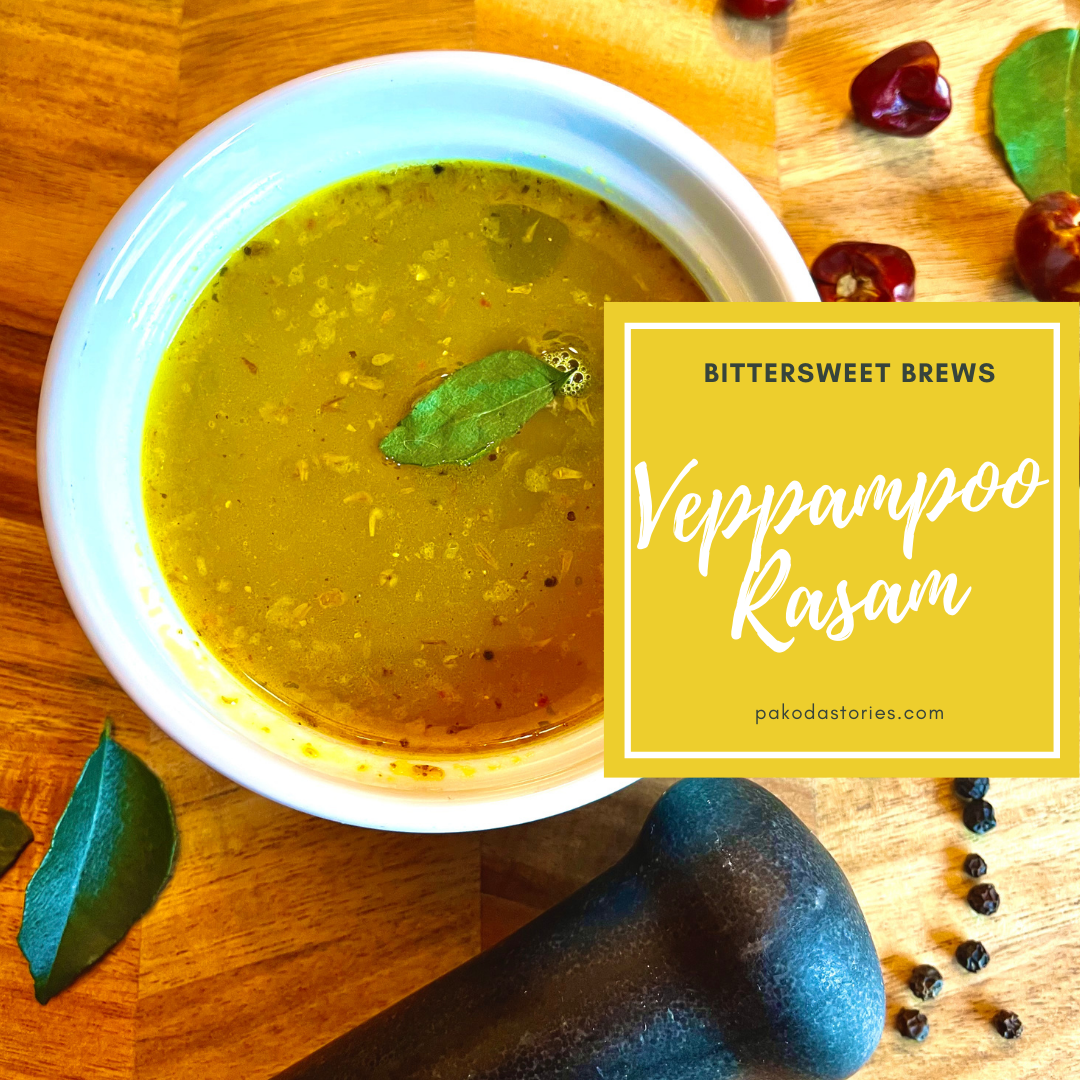
Home-cooked Indian fare is not the typical naan and curry you see in restaurants. Indians do not make greasy bhatures or ghee roasts on the daily. Instead, you will find something as simple and comforting as a plate of Rasam rice and urulai kari. Rasam, to the uninitiated, is a healing, medicinal broth. But this is not everyone’s cup of tea, especially intense recipes like the veppampoo rasam, as the strong, complex flavors can feel unfamiliar. But to those of us who grew up consuming the broth, Rasam is an emotion. It is soothing, nourishing, and instantly grounds you, pulling you back to your roots.
There are many variants of Rasam. In this variant, I use dried neem flowers from my husband’s ancestral home to make a veppampoo rasam for their fragrant and healing properties.
The Composition of Rasam
My mother would always tell me the ideal Rasam combines 5 elements of taste in a balanced, seamless broth – pulippu, kaaram, thuvarppu, inippu, kasappu – Sour, spicy, astringent, sweet, bitter. But remember, the threshold between rasam and sambar is blurry. Even an additional splash of dal can disqualify its status.
Where Rasam is involved, I’m instantly reminded of “Pibare Rama Rasam” originally composed by Sadasiva Brahmendra . Here is the link to the soothing rendition of Pibare Rama Rasam by Karthika Vaidyanathan.
Boats of Rasam
Almost anything sour can help make a hearty Rasam. In terms of consistency, there are two types: one that is drunk and one that is mixed with rice. The former is usually strained or simply scooped from the surface, where the clear broth remains. But the act of tackling the latter mixed with rice on a banana leaf is the slightly feral rite of passage that Tamilians proudly hold on to, similar to the unsavory slurp of Ramen. The wading left, right, front, and back of the Rasam on the banana leaf provides the optimal experience.
The varieties in terms of flavor are endless. You can make Rasam using anything that hits one of the notes mentioned in the composition. I have experimented with making Rasam using different fruits in the past – Strawberry, Cranberry, Watermelon, Pineapple. Pineapple makes some of the most brilliant Rasams that remain etched in your memory forever. And Strawberry is somewhat closer to a Tomato Rasam.
Detox with Neem
Rasam is widely regarded as medicinal, and one such variation involves picking up dropped Neem flowers and drying them to be added to Rasam. The Veppampoo Rasam is typically made at the onset of Indian summers when the blooms of the Neem tree make their first appearance. In Ayurveda, the Neem tree is considered the mother of all medicinal trees, able to cure all ailments. So it only makes sense that Neem flowers have been incorporated into Rasam recipes over several generations.
What is Veppampoo?
Veppampoo is the Tamil word for Neem Flower. The Neem flowers boast an intense scent that is reminiscent of Jasmine flowers and an ambient woodsy note. The petals do not have a sour note. The dried petals become milder in fragrance while retaining their subtle bittersweet flavor. They are infused with a sweet-sour tamarind pulp and completed with a fistful of Jaggery to cut the bitterness of the flowers very slightly.
Veppampoo Rasam Recipe
If there are two things I try to absolutely avoid buying at the Indian grocery store, they are Sambar powder and Rasam powder. I like making my own homemade version because it hits all the notes that me and my family enjoy. I add this powder when making my Veppampoo Rasam to compliment the bittersweet Neem flowers.
On a side note, you can also use the rasam powder to urulai karis and other sauteed vegetables. As for the dried flowers, you can find them at your local Indian grocery store or on Amazon.
Print
Veppampoo Rasam
Veppampoo Rasam recipe from Tamil Nadu that combines bittersweet neem flowers, sour notes of tamarind, and deep jaggery sweetness
- Total Time: 14 minutes
- Yield: 4 servings
Ingredients
- 2 tbsp Dried Neem Flowers
- 1 inch Ginger (crushed in a mortar and pestle)
- 1/2 tsp Turmeric
- 1-2 tsp Rasam Powder
- 2 tbsp Jaggery Powder
- 1-4 Green Chilly (slit)
- 1/2 – 1 cup Water
- 1 tsp Oil
- 1 tsp Cumin Seeds
- 2 tbsp Cilantro Leaves (chopped)
- Coarse Sea Salt (to taste )
To Make the Tamarind Paste
- 2-3 tsp Dry Tamarind
- 2 cups Lukewarm Water
To Make the Spiced Drizzle
- 1 tbsp Ghee
- 1/4 tsp Asafetida
- 1 tsp Mustard Seeds
- 8-10 Curry Leaves
Instructions
- In a medium saucepan, add 1 tsp oil. When the oil is hot, add cumin seeds and cook until they turn brown and fragrant.
- Add the dried neem flowers and sauté for a couple of seconds.
- In a separate bowl, make the tamarind paste by adding a large piece of dry tamarind to 2 cups of lukewarm water. Optionally, you can substitute with 1 tbsp store-bought tamarind paste and 2 cups of water.
- Add crushed ginger, sliced green chillies, salt, turmeric, and rasam powder. Sauté for 1 minute.
- Strain the pulpy tamarind water along with 1 cup of water into the pan. Let this broth boil for 10-15 mins.
- In a separate small pan, add 1 tbsp ghee/oil. Add the mustard seeds. When they start popping, add the hing and curry leaves. Pour this immediately on top of the rasam.
- Finish by adding jaggery and stir to combine. Garnish with chopped cilantro.
Notes
- Increase chilies as per personal heat preference.
- Go heavier on the jaggery if the flowers are too bitter.
- Optional – To add more body to the rasam, you can add 1/2 cup cooked toor dal to the boiling rasam. Let it simmer for 5 mins before adding the spiced drizzle. Adjust water accordingly to the preferred consistency.
- Prep Time: 4 minutes
- Cook Time: 10 minutes
- Category: Main Course, Soup
- Method: Boiling
- Cuisine: Indian
- Diet: Vegetarian